

Staying competitive is a constant challenge for entrepreneurs. This guide explores seven strategies to differentiate your product, exceed customer expectations, and adapt to a changing market.
Focus on customer attraction and retention
Acquiring new customers is important, but retaining existing ones is more profitable. The probability of selling to an existing customer is 60–70%, versus 5–20% for a new one. A 5% increase in customer retention can boost profits by 25–95%.
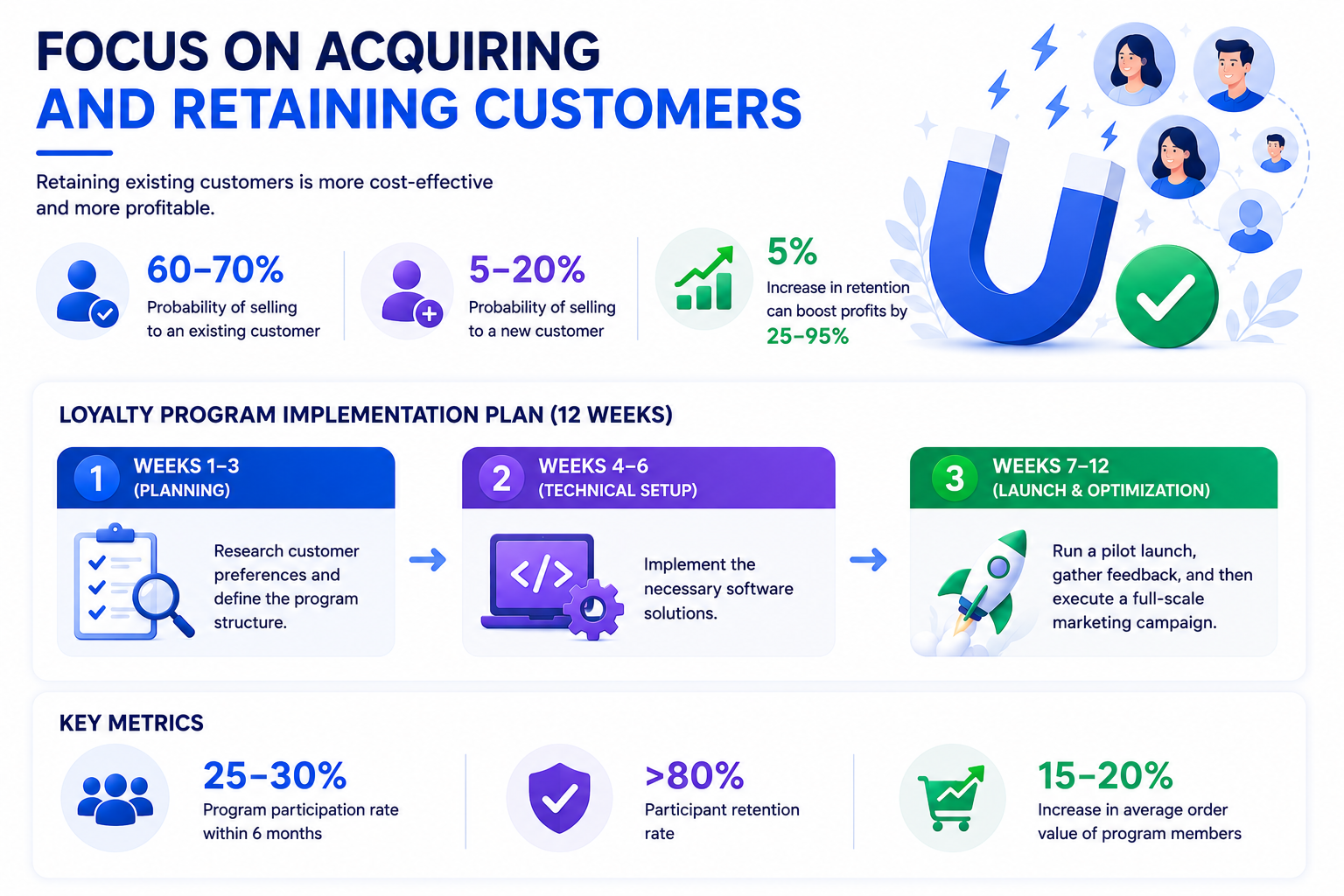
A customer loyalty program can be implemented in 12 weeks:
- Weeks 1–3 (Design): Research customer preferences and define the program’s structure.
- Weeks 4–6 (Tech setup): Implement the necessary loyalty software.
- Weeks 7–12 (Launch & optimization): Start with a soft launch, gather feedback, and then roll out a full marketing campaign.
Key metrics: Aim for a 25–30% enrollment rate in six months, an 80%+ member retention rate, and a 15–20% increase in average transaction value for members.
Maintain a long-term business vision
A long-term vision is crucial for innovation. As Henry Ford and Steve Jobs knew, customers often don’t know what they want until you show them.
Strategic planning framework:
- Quarterly market trend analysis: Monitor what customers buy and say they need.
- Monthly customer feedback integration: Listen to customer problems and desired solutions.
Measurement methods: Use Net Promoter Score (NPS) surveys (target >50), customer satisfaction (CSAT) ratings, customer advisory boards, and social media sentiment analysis.
Leverage AI for a competitive advantage
AI can increase productivity and scalability. Currently, 78% of organizations use AI in at least one business function.

AI implementation framework:
- Weeks 1–4 (Assessment): Identify how AI can refine operations.
- Weeks 5–8 (Pilot testing): Test tools like generative AI or analytics software to gain insights and identify risks.
- Weeks 9–16 (Full implementation): Train employees on best practices to avoid misuse.
Success Metrics: Target automating 30-40% of repetitive tasks, saving employees 4-6 hours weekly, and reducing customer response time by 50%.
Optimize your pricing strategy
A dynamic pricing strategy helps you offer value, maintain profitability, and respond quickly to market changes.
Pricing framework:
- Weeks 1–3 (Market research): Select and test a pricing model.
- Week 4 (Cost Analysis): Review production costs and target profit margins.
- Weeks 5–8 (A/B testing): Refine your strategy using competitive pricing software and customer surveys.
Track price elasticity, competitor price gaps, customer acquisition cost vs. lifetime value, and market share.
Invest in employee development
Investing in your employees’ careers is an investment in your company’s future; 94% of employees would stay longer at a company that invests in their growth.
Professional development framework:
- Weeks 1–4 (Needs analysis): Identify skill gaps and opportunities.
- Weeks 5–8 (Program design): Get employee input to create relevant training opportunities.
- Weeks 9–24 (Implementation): Launch programs, establish check-ins, create mentorship pairings, and track progress.
Metrics: Aim for 80%+ training satisfaction, filling 70% of promotions internally, and a 25% decrease in first-year turnover.
Diversify your offerings
Adapting to market changes often means exploring new markets and diversifying your products.
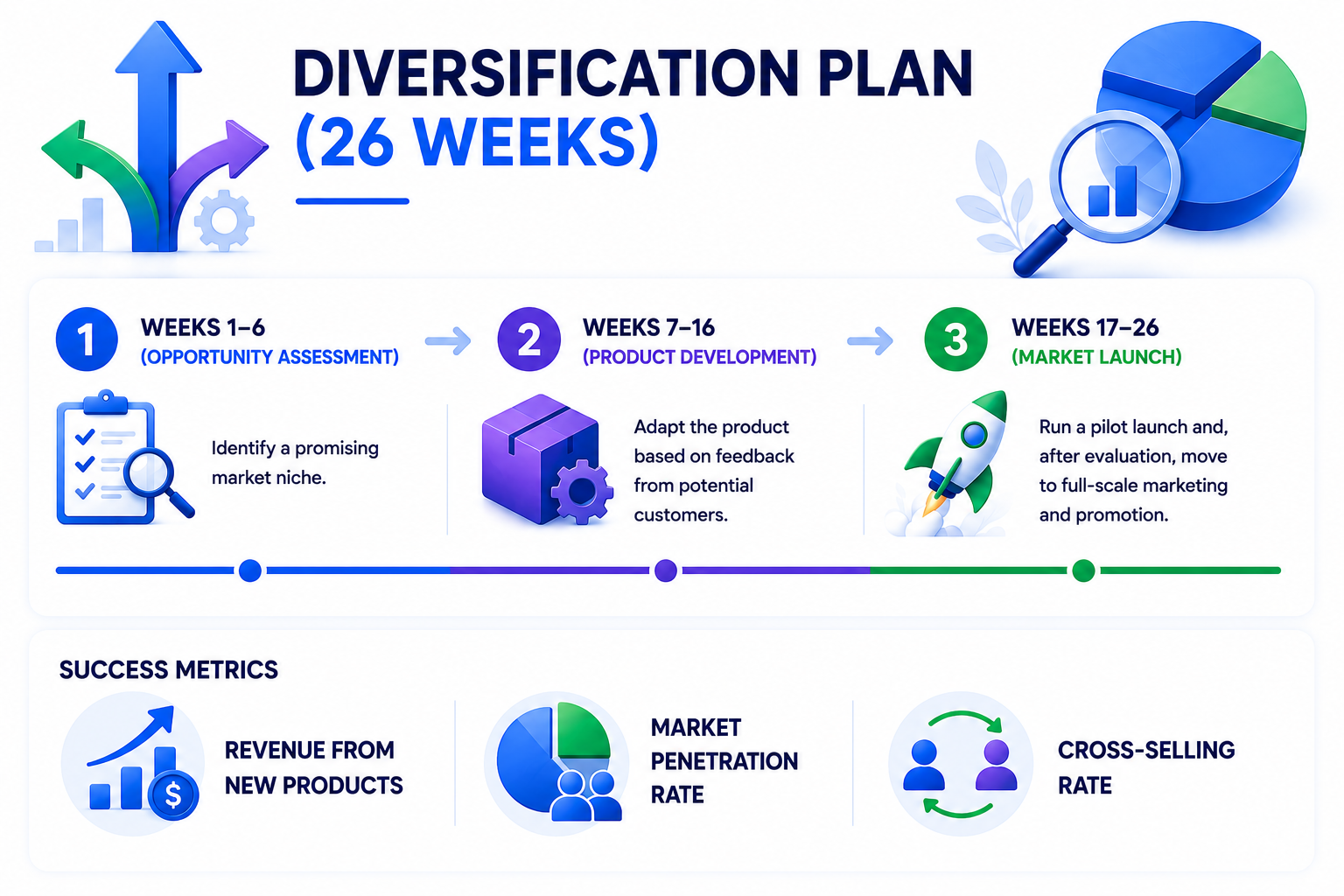
Product diversification framework (26 weeks):
- Weeks 1–6 (Opportunity assessment): Identify a niche market.
- Weeks 7–16 (Product development): Use customer feedback to refine a product for the new niche.
- Weeks 17–26 (Market entry): Start with a soft launch before scaling up.
Measure success by tracking revenue from new products, market penetration rate, and customer cross-selling rate.
Monitor your competition
Regularly track your competition’s social media, SEO, content, website, and pricing using tools like Hootsuite, Semrush, or Ahrefs.
Competitive analysis (SWOT) framework:
- Weeks 1–2: Collect data on competitors.
- Weeks 3–4: Conduct a SWOT analysis to find market gaps.
- Weeks 5–6: Develop a strategy to address those gaps.
Establish quarterly competitive intelligence reporting to stay updated on your market position, threats, and opportunities.