

Unlike many business-idea lists that provide only a brief description, this guide presents unique opportunities supported by data. Each idea includes information about market potential and startup costs.
You will also find monetization models, competition details, and ways to validate the concept. This helps entrepreneurs make informed decisions from the start.
The guide covers business ideas for a wide range of budgets. They range from approximately $500 to $50,000 for solo entrepreneurs and technical teams.
The most promising global business trends
Before looking at specific ideas, it is important to understand the global trends creating new opportunities. The most successful companies often emerge by riding these waves of change.
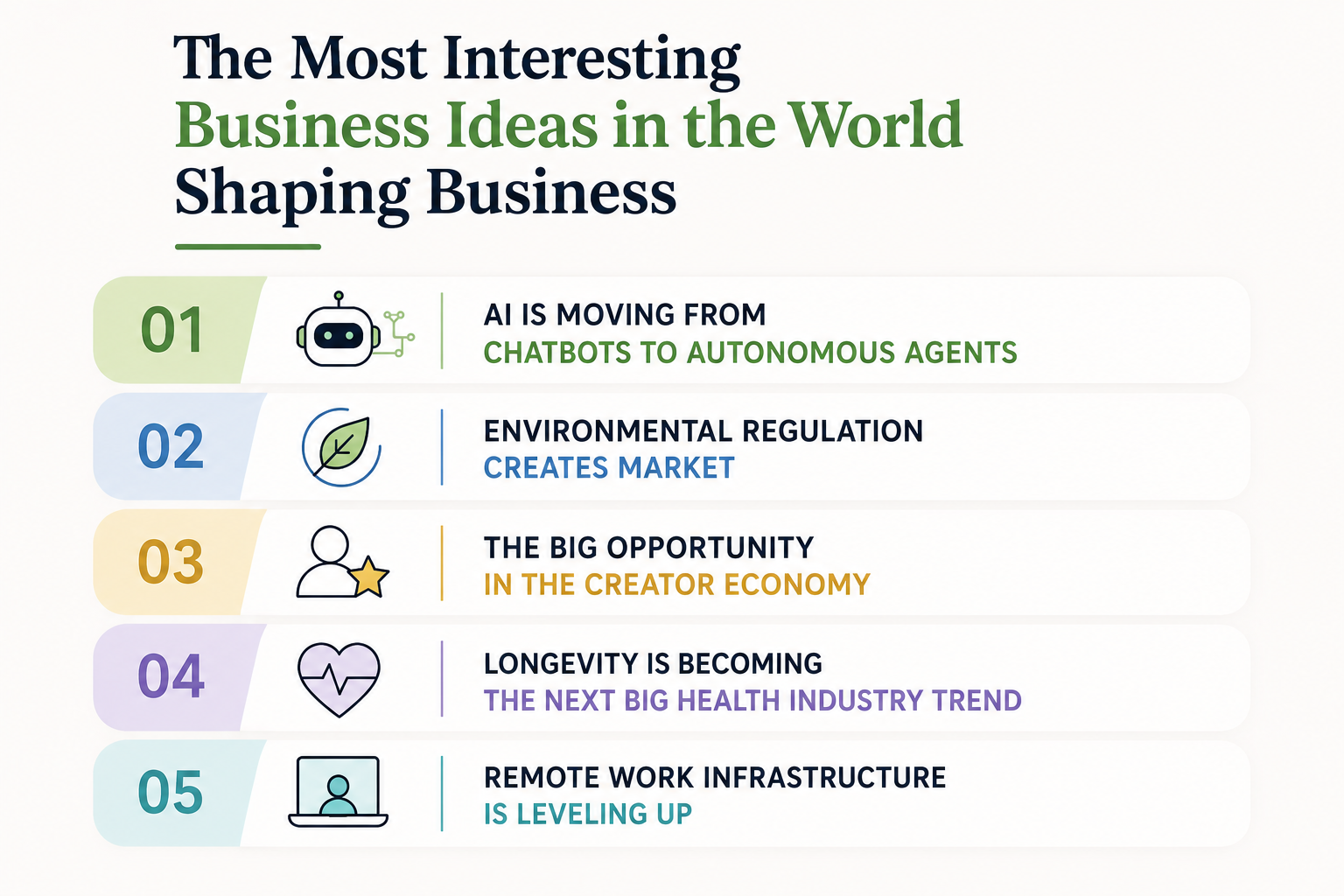
- Artificial intelligence is moving beyond chatbots to autonomous agents. The corporate AI agent market is growing rapidly. Forecasts suggest it could expand to more than $1 trillion by the end of 2025. The focus is shifting to agentic AI capable of independently executing business processes. This creates major opportunities for specialized solutions in law, healthcare, and finance.
- Environmental regulations are creating new markets. Regulations like the European CSRD Directive affect more than 50,000 companies. New SEC climate-disclosure requirements are also driving demand for compliance tools. Businesses need solutions for carbon accounting and ESG reporting. Many organizations still rely on spreadsheets, leaving this market far from saturated.
- The creator economy represents a major opportunity. In 2025, the creator economy surpassed $20 trillion. Yet, most content creators still use between 8 and 12 separate tools for payments, analytics, and community management. The most attractive opportunities lie in infrastructure tools that help creators build and scale their businesses.
- Longevity is becoming the next major health trend. GLP-1 medications have brought health optimization into the mainstream. This has increased demand for biomarker monitoring, personalized supplements, and coaching programs. The global longevity market is projected to approach $50 trillion by 2028.
- Remote-work infrastructure is reaching a new stage. Although 58% of office workers operate in hybrid or remote environments, many tools still fail. Companies continue to struggle with asynchronous collaboration and corporate culture. Businesses that solve these challenges have significant growth potential.

What this means for entrepreneurs
The most successful business ideas often exist at the intersection of several global trends.
Here are a few promising examples:
- An AI agent for automating climate-compliance reporting.
- A platform for longevity and wellness professionals.
- A service supporting remote ESG consultants.
These specific niches typically offer lower competition and much higher profit potential for new founders.
How to choose the right business idea
A great idea is not always the right idea for you. Use the following framework to evaluate your options based on resources.
- If your budget is under $1,000. Focus on service-based businesses such as consulting, coaching, freelancing, or no-code product creation. Remote-work and creator-economy opportunities can often be launched with minimal upfront investment.
- If your budget is between $1,000 and $10,000. This amount is sufficient to build a minimum viable product (MVP). Excellent options include niche SaaS products, AI-powered automation services, and ESG consulting businesses.
- If your budget is up to $50,000. You can comfortably hire developers, invest in paid marketing, and build more sophisticated products. High-potential opportunities include healthcare-focused AI agents and climate-tech solutions.
- If you are a non-technical founder. Leverage your unique industry expertise. Start with services to generate revenue quickly, or use no-code platforms like Bubble, Webflow, and Airtable to test prototypes.
- If you are a technical founder. Consider complex projects involving AI and machine learning, vertical SaaS platforms, and biotech solutions. Your technical expertise can be a major advantage where technology remains outdated.
- If your goal is passive income. Explore digital products, online marketplaces, or self-service SaaS businesses. Creator-focused tools and niche software products are particularly attractive opportunities for this model.